His Own Study First, Then Other People's Labs.
Published Author · Research Assistant, Harvard Business School and Columbia University
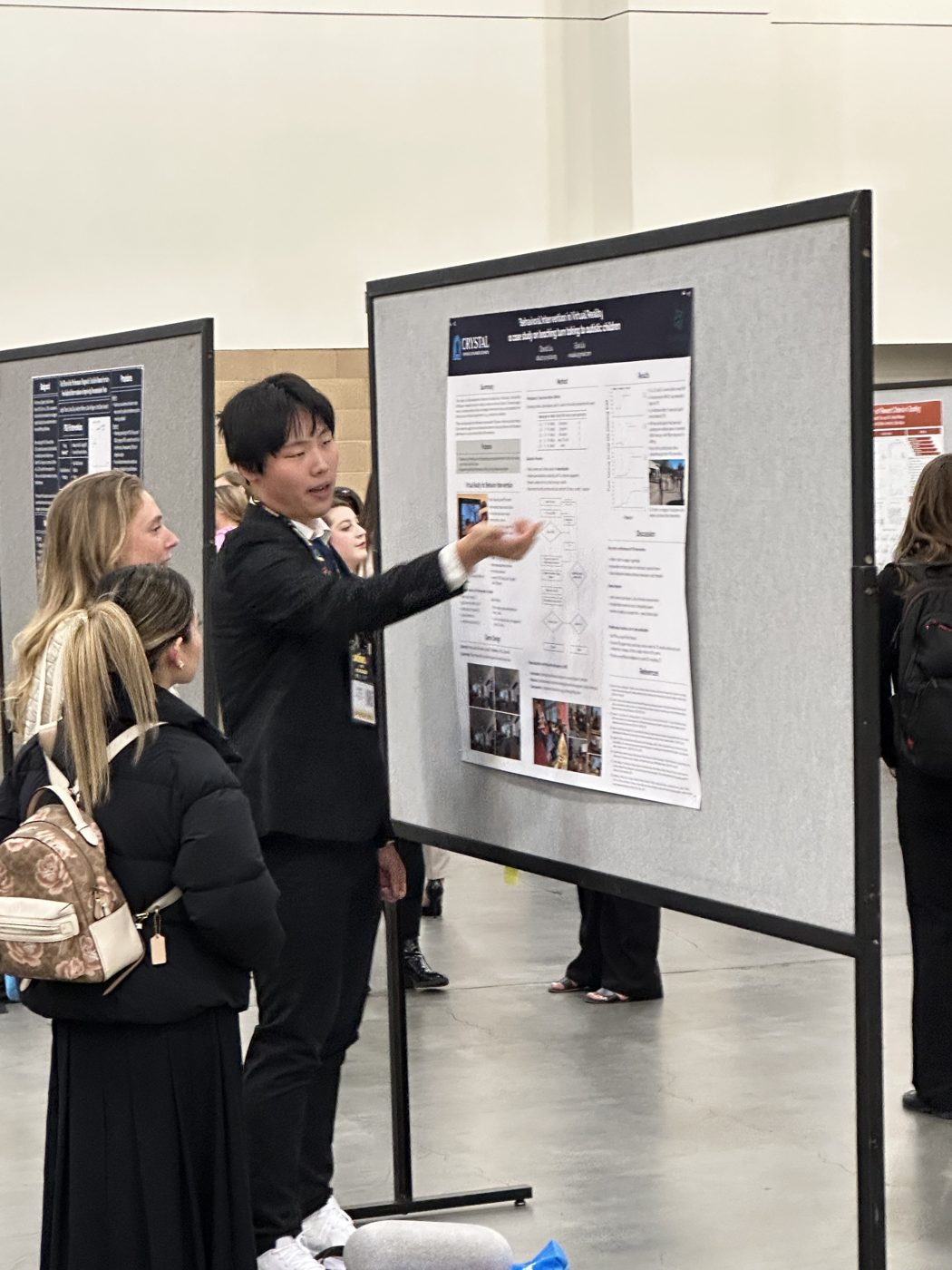
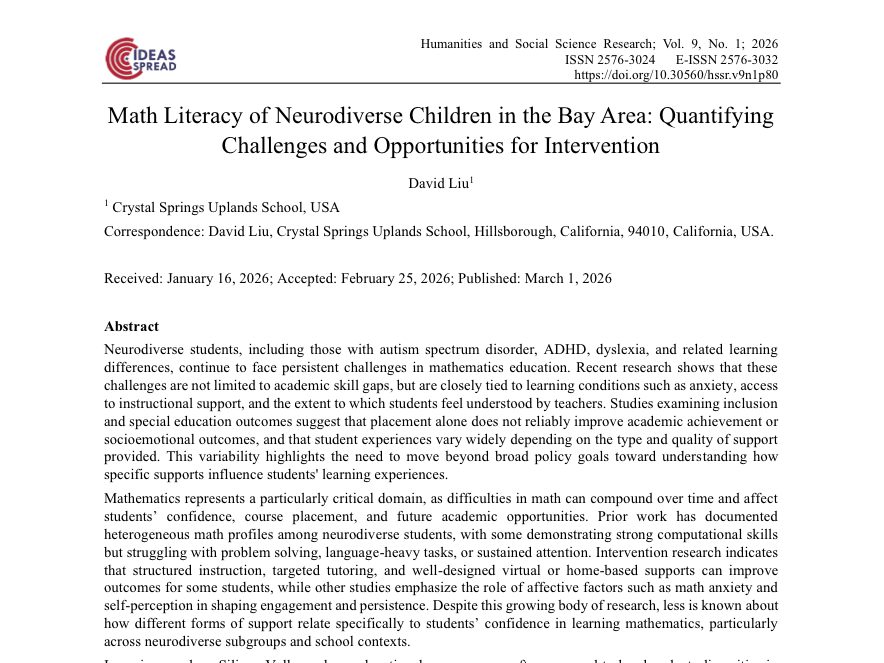
David Liu's first research project was his own. Between June and December 2025 he wrote a survey instrument, collected 108 responses from neurodiverse middle and high school students in Silicon Valley, and did the statistics himself. The paper came out in March 2026 with his name alone on it.
Since June 2026 he has also worked as a research assistant on other people's questions: for Professor Michael Lingzhi Li at Harvard Business School, on how healthcare artificial intelligence is checked before and after it reaches patients, and at the EMBRace Lab at the Columbia University School of Social Work, under Professor Riana E. Anderson, on racial stress and a mental-health app for adolescents.
In the future, David hopes to study statistics and policy evaluation, and to keep running his own surveys rather than only reading other people's.
Math Literacy of Neurodiverse Children in the Bay Area
Independent study, June to December 2025 · Sole author · Humanities and Social Science Research, vol. 9, no. 1, March 2026
The starting point was the gap in educational outcomes for children with special needs in a region where resources are assumed to be abundant. Rather than borrow a questionnaire, David wrote one, built on the PISA framework for mathematical literacy, and reached families through parent groups, regional disability networks and autism-focused forums. Responses were analyzed with descriptive statistics and cross-tabulation; the composite measure of students' mathematics experience had a Cronbach's alpha of 0.85.
What came back was blunt. Only 1.6 percent of respondents said they had never felt discouraged or anxious about mathematics because of their disability. Students with anxiety, attention difficulties or low confidence were two to three times as likely to call mathematics stressful or hard to focus on. Students with ADHD-like attention profiles were the most enthusiastic about hands-on and immersive learning, with more than 85 percent saying they learn better with movement or interactive tools; students with anxiety wanted private, self-paced practice and one-on-one feedback rather than public questions. The paper pairs each finding with an intervention a school could actually run, and closes with its own limits: a voluntary sample of 108 and self-reported diagnoses.
Only 1.6% of students reported never feeling discouraged or anxious about learning math due to their disability, showing that math-related anxiety and self-doubt are nearly universal among students with special learning needs.From the paper's results
The survey and the virtual reality work are the same project seen from two sides: two of the survey's closing questions ask whether a student would find mathematics taught through VR interesting, and whether they would practice with it at home.
Math Literacy of Neurodiverse Children in the Bay Area: Quantifying Challenges and Opportunities for Intervention
University labs
Harvard Business School
Research assistant to Professor Michael Lingzhi Li, since June 2026
The question is how healthcare artificial intelligence gets checked before and after it is put in front of patients. David's part is the literature review, organized around clinical validation, generalizability, auditability and post-deployment monitoring. He reads peer-reviewed studies and regulatory frameworks against each other and files a weekly written report of summaries, synthesis and gaps, which feeds a framework paper being developed in the group.
EMBRace Lab, Columbia University School of Social Work
Research assistant to Professor Riana E. Anderson, since June 2026
Two projects. The first is literature on ethnic-racial socialization, discrimination, identity development and the factors that protect the mental health of racially and ethnically marginalized adolescents; David reviews scholarship and gives feedback on a manuscript's argument and organization. The second is TNT, a culturally responsive digital mental-health app for adolescents coping with racial stress; he reviews its activities and content for accessibility and relevance and collects feedback from the young people who would actually open it.
Science fairs
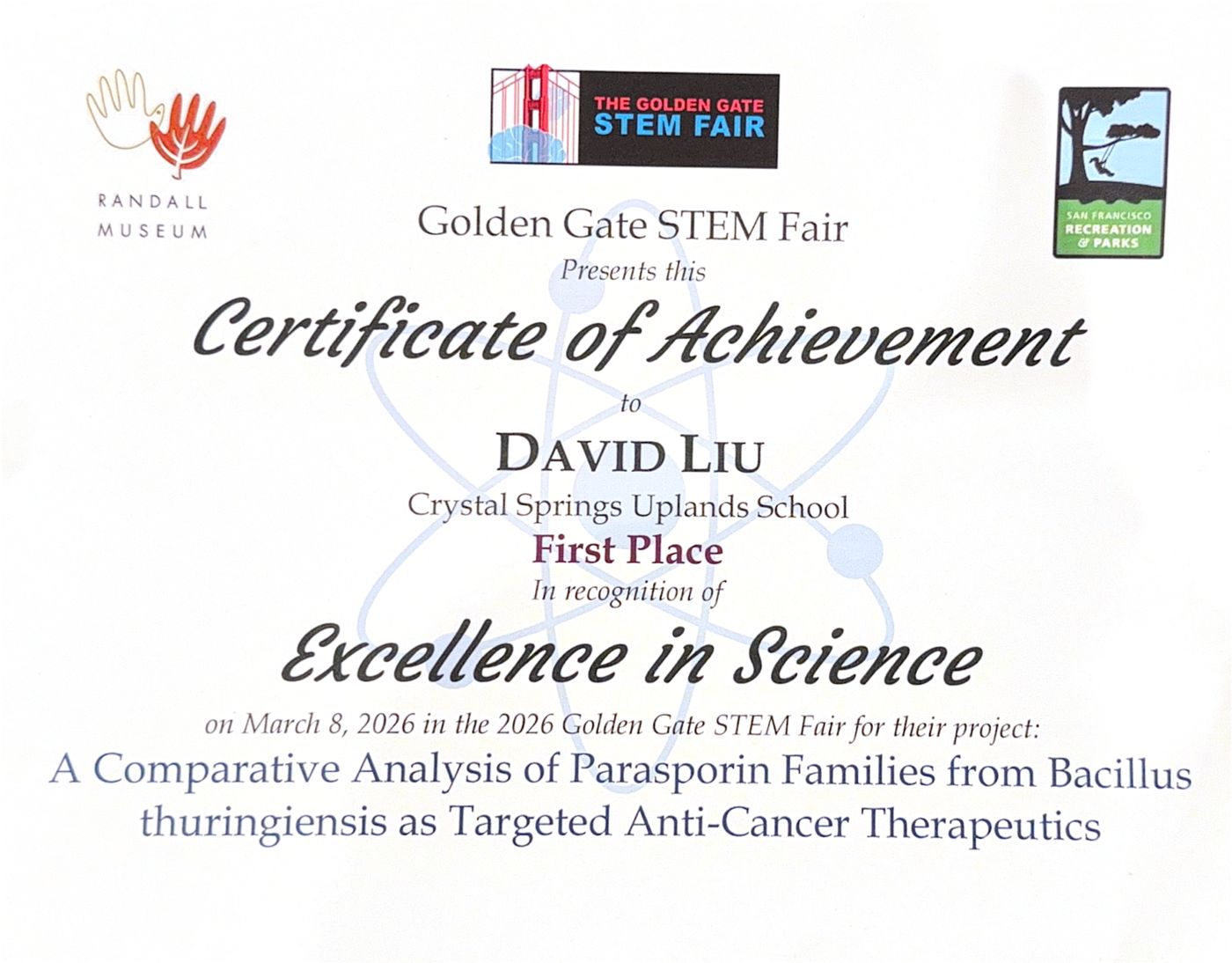
- First Place, Golden Gate STEM Fair, 8 March 2026, for "A Comparative Analysis of Parasporin Families from Bacillus thuringiensis as Targeted Anti-Cancer Therapeutics", a separate project in biology.
- American Psychological Association award for Achievement in Research in Psychological Science, Alameda County Science & Engineering Fair, 2025.
- First place in category, Alameda County Science & Engineering Fair, 2025.
- First place in category, Junior Science and Humanities Symposium, Northern California section, 2025.
- Honorable Mention, Scholastic Art & Writing Awards, 2026.
- Participant, California Science & Engineering Fair, 2026.
Training, and one club
Quantitative Analysis in Public Policy, University of Chicago
Summer Immersion Program, June to July 2025
Statistical data and mathematical modeling turned on public policy, from collecting the data to analyzing it to reading what has already been written. David led the group discussions for 20 students and gave the final project presentation.
SNP-Reach, Stanford Center for Neurodiversity and Human Potential
June to July 2026
The center's research, education and advocacy camp for high school students: the science of neurodiversity, inclusive education, universal design and advocacy, taught by Stanford faculty and people working in the field. He built an interactive site there that walks a person through pausing, reflecting and responding safely in a moment of impulsive urge.
Bring Change to Mind
Vice president of the school club, since September 2025
An hour a week on teen mental health, which is where the survey's respondents and the lab's app users live.